

Your home, what do you see? The happy memories you’ve happily collected over the years or do you see so much clutter you find it hard to relax and enjoy your surroundings.
During your years on earth, you’ve collected pieces that yes, are dated but hold sentimental value and you still love them. You have lovingly selected these collectibles to help remind you of happy memories from your travels, milestones etc. However, recently, you find yourself at a cross-roads of sorts, because your home is becoming more and more cluttered. You may want to reconnect your home with today’s decor and yet still can’t let go of these prized pieces. Unfortunately, no-one in your life, not family or friends feel the same way about the beautiful pieces you’ve collected over the years so passing them to loved ones isn’t an option.
“Clutter is an overabundance of possessions that collectively create chaotic and disorderly living spaces”
Joseph Ferrari, a professor of psychology at DePaul University in Chicago”

So, what effect can clutter have on us? I don’t think it’s a surprise that research has shown too much can have a negative impact. Here are some ways it may be affecting you.
1) Stress Levels
Living with clutter around us can increase our stress levels and make it hard for us to relax. One study showed women who had more clutter in their homes had higher levels of the stress hormone cortisol compared to women who lived with less clutter. Another showed the person with more sense of responsibility for everyday upkeep of their home had increased levels of cortisol.
2) Procrastination
Procrastination is linked to clutter. I think it is something most people can relate to, we tell ourselves we’ll get to it or we don’t have the time. Tackling the task can be for many daunting and overwhelming causing many to avoid dealing with it which in turn causes the clutter to pile up.
“It’s human nature to take the easy route and leap at storage methods that promise quick and convenient ways to remove visible clutter. Putting things away creates the illusion that the clutter problem has been solved. But sooner or later, all the storage units are full, and the room once again overflows with things.”
3) Focusing
You may have difficulty focusing on your task/work if you are surrounded by clutter.
According to research our brains like order. If we are giving it constant visual reminders of disorganisation it can drain our cognitive resources. This will in turn, reduce our ability to focus, cause frustration and can reduce our working memory.
“Clutter forces the brain to consume energy. Create uncluttered environments instead”
Carmine Callo
Here are some common reason why we hang on:
1) Sentimental Value
These piece are anything you’ve formed an emotional attachment to. This can be different for many people. Your children’s artwork or something given to you by a passed loved one. However, when you have an overflow of these pieces, it can make it hard to treasure the truly special pieces and holding on to the past can make it hard to embrace and enjoy the present and what may come in the future.
2) You think you might need it again
We’ve all done it, we tell ourselves that this may come in handy one day and find it many years later while looking for something else!
3) It’s my next project/hobby.
Whether it be the sewing, knitting or painting, you were going to take up. This project/hobby never started to begin with and its collecting dust in the corner.
4) Guilt
The two main reason we tend to keep things out of guilt are firstly, a loved one gave it to us and secondly, it cost a lot of money. If it was given by a loved one, ask yourself, will this person still like/love you and you them if you give it away? I bet the answer is yes! If it cost you a lot of money, ask yourself is it really worth hanging on to, taking space up in your home. You made a mistake, we all do, if no one else wants it you can either sell it on or give it to someone who needs it.
5) No Time
It’s very easy to throw something aside and say I’ll deal with it later. Before long you’ve a mountain of stuff, in several rooms that you’ve “been meaning to get to” and now it’s an even more off putting task.
Here’s how to tackle your clutter
Experts say there are different contributor to clutter: lack of support, lack of focus and lack of systems.
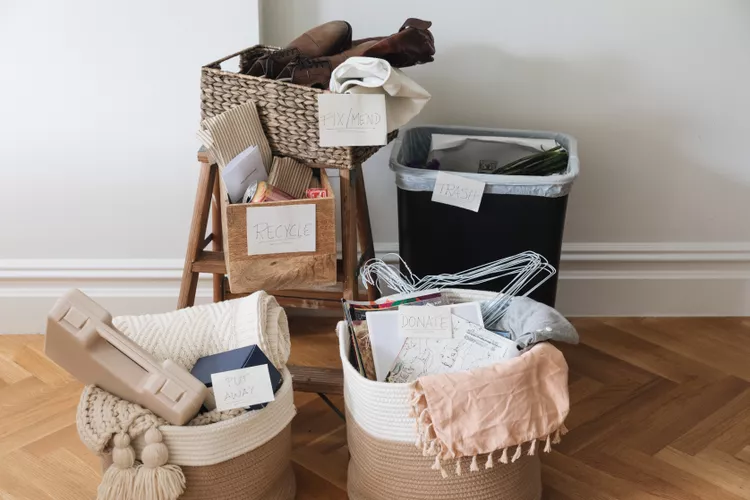
Before you start, you need to prioritise the most important tasks, you need to identify how you need to accomplish these tasks and you need to implement it. What structure or “system” do you need? There isn’t a one size fits all approach. Whether you are at work or at home, this needs to be a collective effort. Everyone needs to work together in order for the tasks to be completed and the system maintained. For example, you have reorganised the playroom. Your “system” has legos in one box, dolls in another and so on. Everyone (including the kiddies) needs to work to make sure they all go back into the right box.
If you have an office desk, you need to organise this so everything you need is at hand, tidy and organised in order for you to work most efficiently.

“The best way to find out what we really need is to get rid of what we don’t.”
Marie Kondo
My advice, would be to start with those “nuisance” pieces. They tend to be easier to let go. This item may have been bought or gifted to you and at that time in your life you loved them. They, as Marie Kondo would say, brought you “joy”. Now if it no longer brings you that same “joy” why not let someone else enjoy them the way you did. These could help ease any guilt about letting them go.
When, or if, you decide to deal with the sentimental or emotional clutter it may help to have a loved one with you. You may, also, find it helpful, to deal with it in sessions. Dealing with this clutter this way, can help you not burn yourself out.
“Picture your dream home. I bet it’s not filled with clutter.”
Joshua Becker
When sorting through your items, experts recommend separating as you go. For example, you could have four boxes. One for keeping, one for donating, one for selling and one as your bin (or if its paper this could be your recycle box). They also recommend, as you are sorting ask yourself these types questions: 1) Would I buy it again and pay full price? 2) If someone you didn’t like, gave this to you would you still want to keep it? 3) Does this item give you happy memories? If you answered no to these questions then it may be time to let it go. Don’t let holding on to something hold you back from embracing new memories into your home.
“What I know for sure is that when you declutter – whether it’s on your home, your head, or your heart – it is astounding what will flow into that space that will enrich you, your life, and your family.”
Peter Walsh, Lose the Clutter, Lose the Weight: The Six-Week Total-Life Slim Down
It may help to remind yourself of how good you feel when your done. Imagine that “finally, I’m done!” feeling.
I hope you found this useful and I finish with a quote by William Morris who famously quoted:
“have nothing in your houses that you do not know to be useful or believe to be beautiful.”
William Morris
Leave a Reply